Dublin Core
Title
Bo Knows III
Subject
Public Art
Description
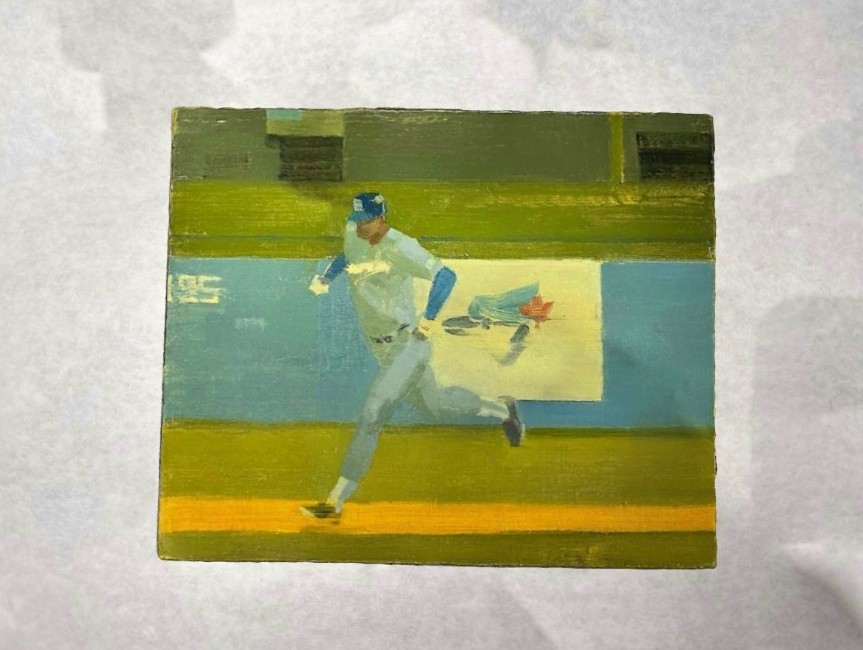
Nathan Mullins’ “Play Ball” exhibit preserves a form of cultural heritage centered on baseball, sports fandom, and personal memory. Mullins, a painting professor at the University of Southern Mississippi, created the series using oil paint on panels, drawing inspiration from baseball cards, televised games, and highlight reels that he remembered from childhood. This specific painting depicts the baseball star Bo Jackson. Mullins first created small oil paintings based on these memories and broadcast images and then used those works to create larger paintings, allowing the images to become more and more abstract. His emphasis on the colors and lighting of baseball uniforms, along with the isolated figures taken from television broadcasts, gives the work meaning while also highlighting the interesting contrast between the individual athlete and baseball as a team sport.
Creator
Nathan Mullins
Source
SVPA Art Gallery
Date
circa 2026
Relation
2000 – present
Format
Oil on panel depicting a baseball player running the bases.
Type
Decorative Artwork
Identifier
Decorative Arts
Coverage
Hattiesburg
3D Model Item Type Metadata
Creator
Center for Digital Humanities, University of Southern Mississippi
Contributor
Original artwork: Nathan Mullins
3D capture: Ethan Ruff
Processing and documentation: Ethan Ruff, Ramsey Ruff
Project supervisor: Dr. Courtney Luckhardt
Metadata lead: Ethan Ruff
Narrative: Ethan Ruff
3D capture: Ethan Ruff
Processing and documentation: Ethan Ruff, Ramsey Ruff
Project supervisor: Dr. Courtney Luckhardt
Metadata lead: Ethan Ruff
Narrative: Ethan Ruff
Data Management
Data available upon request.
Date Digitized
September 21, 2026
Description
A simple photograph of this artwork does not do it justice. The 3D scan and overhead lighting provide for immense detail down to the brushstroke. The shape and depth of the scan make it seem as if you are experiencing the painting rather than simply looking at it. A single photograph would miss the shading at different lights, the small amounts of paint that spills over to the sides of the canvas, or the ability to zoom in and see the incredible attention to detail in the shading of the artwork. Surface details like the light reflecting off of the brushstrokes and the subtle-but-human spillover of paint contributes to the ability to relate to and experience this artwork. While the model is amazing in experiencing more of the artwork, the painting is truly unique in person. The model is unable to fully capture the compounded layering of the oil paint or the shine of the colors at different angles that only continue to add to the experience.
Format
GLB file
Rights
This item and its digital surrogates are provided for educational and public humanities use; reuse or redistribution requires permission from the holding institution and the Center for Digital Humanities at the University of Southern Mississippi.